Land Back Task Force
The Land Back Task Force
The Land Back Task Force exists to research, learn, and engage both District of Squamish residents and Sḵwx̱wú7mesh People on the concept of public Land Back.
The scope of work does not involve
privately owned property,
and residents with private land holdings
will not be impacted.
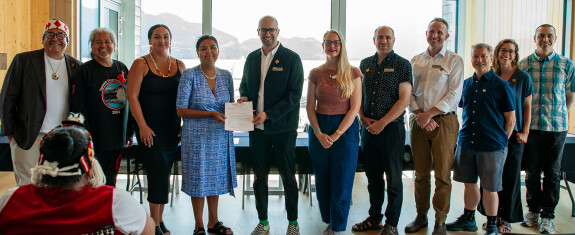
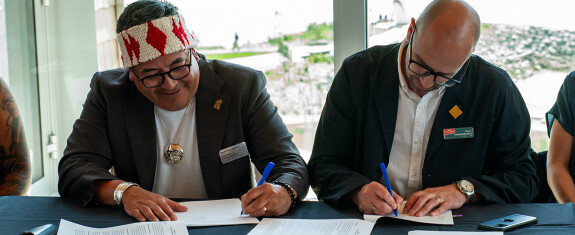
This initiative is a Priority Activity identified in the Wa Iy̓ím ta Sḵwx̱wú7mesh Memorandum of Understanding (MOU), signed on July 22, 2025, to identify shared opportunities to advance reconciliation.
What Land Back Means in Squamish
The Land Back Task Force is a reconciliation-driven initiative that responds to the historical alienation of Squamish People from their land. The task force’s scope of work does not involve privately owned property, and residents with private land holdings will not be impacted.
The Task Force will focus on restoring Sḵwx̱wú7mesh Nation governance, stewardship, and cultural connection to lands currently under public jurisdiction. This may include:
- Co-managing parks and protected areas.
- Restoring original place names.
- Granting exclusive access to cultural sites for Sḵwx̱wú7mesh People.
- Facilitating access to traditional harvesting sites.
- Exploring opportunities to recommend policy updates for District land dispositions.
Purpose and Goals
The primary goal is to develop a framework for what Land Back possibilities could look like within the District of Squamish, including:
- Researching external examples of Land Back initiatives to inform the local process.
- Creating mechanisms for shared decision-making, co-management and policy development that respect Sḵwx̱wú7mesh jurisdiction.
Guiding Principles
The MOU is grounded in values shared by the District of Squamish and Squamish Nation.
- tkwáya7n iy nexwnew̓ítm – Listen & Engage.
- wa nexwniwnen chet ta nexwniw̓ tl’a Sḵwxw̱ú7mesh – Follow the Ways of the Squamish.
- tex̱wlám̓ ns7eyx̱ – Genuinely Care.
- chet wa telnexw tina tl’a snewiyelh tl’a Sḵwx̱wú7mesh – Learn the Advice of the Squamish.
- na wa nelhnilhtway ta úxwumixw – The People Go Through It Together.
- we7us chet ta Sḵwx̱wú7mesh siyá̓m̓in – Protect the Rights and Title of the Squamish.
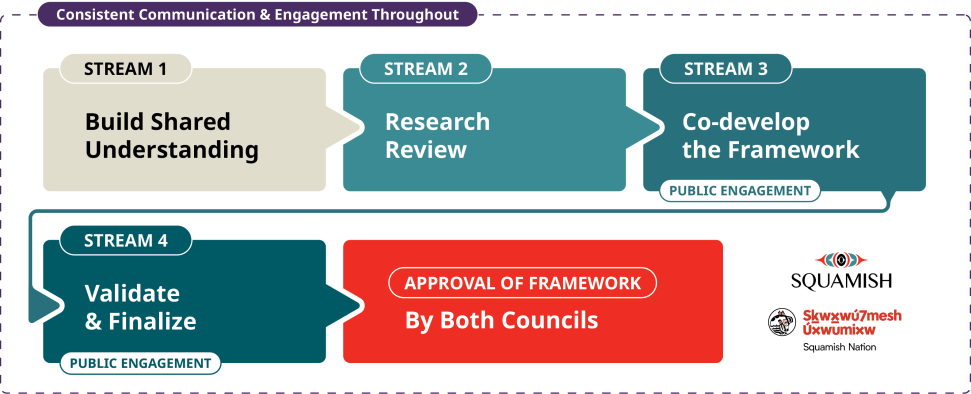
Engage, research, recommend, learn together
The task force itself does not have decision making power; it is a coordinated engagement and research effort on behalf of both Councils. The task force will research and engage in meaningful dialogue, both among its members and the public, and make recommendations to the respective Councils.
View a list of compiled RESOURCES to learn about the historical facts and legal frameworks for Indigenous rights and title in Canada to help contextualize recent court decisions, build historical literacy and ground public dialogue.
FAQs
The Land Back Task Force exists to research, learn, and engage both District of Squamish residents and Sḵwx̱wú7mesh People on the concept of Land Back. Its primary goal is to develop a framework for Land Back in the District of Squamish that focuses on restoring Squamish Nation governance, stewardship, and cultural connection to lands currently under public jurisdiction, including:
- Researching external examples of Land Back initiatives to inform the local process.
- Creating mechanisms for shared decision-making, co-management and policy development that respect Sḵwx̱wú7mesh jurisdiction.
The term “Land Back” is referenced in the MOU and means exploring possibilities for the return or co-management of public lands in a way that respects Squamish Nation Rights and Title. In broader discussions, “Land Back” is described as restoring Indigenous governance, stewardship and cultural connection over Squamish lands while addressing historical injustice.
No. The scope of work does not involve privately owned property, and private land holdings will not be impacted. The work is to explore how public lands can be returned or co-managed in ways that uphold Indigenous rights and benefit the broader community.
It focuses on restoring Sḵwx̱wú7mesh Nation governance, stewardship, and cultural connection to lands currently under public jurisdiction.
The task force work will focus on land that the District of Squamish currently controls or manages. It may also look at how to support the Sḵwx̱wú7mesh Nation regarding Crown land (land owned and managed by the provincial or federal government).
No. The intent is not privatization but exploring how public lands can be returned or co-managed in ways that uphold Indigenous rights and benefit the broader community.
The Task Force is a time-limited committee that adopts a consensus-based approach for internal discussions, engagement with the community, and recommendations to each Council.
The Task Force does not have the authority to make binding decisions or act on behalf of either government.
All decisions regarding Land Back initiatives, policy changes, or land dispositions remain with the Sḵwx̱wú7mesh Nation Council and District of Squamish Council.
Potential initiatives include, but are not limited to, co-managing parks and protected areas, or granting exclusive access to cultural sites for Sḵwx̱wú7mesh People. Other examples involve facilitating access to traditional harvesting sites, and restoring original place names. The Task Force will also explore opportunities to recommend policy updates for District land dispositions, and advocate for Sḵwx̱wú7mesh Nation as it relates to Crown land dispositions.
Membership includes three Councillors appointed by Sḵwx̱wú7mesh Nation Council and three members of Council appointed by District of Squamish Council. Staff from both governments provide administrative and technical support throughout the project.
The six members of the task force are:
- Councillor Is’gh’li-ya, Anthony Joseph (Squamish Nation)
- Councillor Kalkalilh, Deanna Lewis (Squamish Nation)
- Councillor Jonny Williams (Squamish Nation)
- Councillor Eric Andersen (District of Squamish)
- Mayor Armand Hurford (District of Squamish)
- Councillor Jenna Stoner (District of Squamish)
The Task Force will approve a plan to engage with District residents and Sḵwx̱wú7mesh People on the topic of Land Back. Engagement activities will be trauma-informed, respectful, and designed to promote thoughtful discussion. Task Force members will also attend engagement sessions and events as required.
As a first step, District residents are invited to join in learning about the historical facts and legal frameworks for Indigenous rights and title in Canada to help contextualize recent court decisions, build historical literacy and ground public dialogue.
A public Learning and Dialogue series of speaker events is also being planned with the Squamish Public Library, with dates to be announced.
The Terms of Reference attached to the Report to Council were adopted by Council at the March 17, 2026 Regular Meeting.
The Brackendale Farmers Institute Park lands are zoned as P-3-Park. Ownership of these lands is the Crown (Provincial).
The District and Squamish Nation have committed to pause any development on these lots. This commitment is required now because the construction of the Cheekeye Debris Flow Barrier (currently underway) unlocks the potential to change land uses for the lands.
They also agree to explore supporting a potential request to transfer this crown (provincially owned) land to the Squamish Nation. The potential also exists for a co-created vision and land use plan for the area.
The 2011 Intergovernmental Cooperation Accord between the District and Squamish Nation included a clause that the Squamish Nation would support the Province transferring ownership of these lands to the District as part of the larger development of the lands by the Squamish Nation. Now, with the change in provincial legislation (DRIPA) and Indigenous truth and reconciliation context since that time, the current discussions are about co-management and reconciliation for these ancestral lands.
The MOU does not change how development is approved nor does it create new legal barriers. The District remains committed to transparency and fairness in permitting. All projects, including those from Squamish Nation, follow the same due process as other community projects.
Glossary of Terms
A governance model characterized by shared decision-making, policy development, and stewardship responsibilities between the District of Squamish and Sḵwx̱wú7mesh Nation. This model could be applied specifically to lands under public jurisdiction, such as parks and protected areas.
A process for internal Task Force discussions where representatives work to achieve collective agreement. Under this model, the Task Force would develop recommendations for the Land Back framework but does not hold the authority to make binding legal decisions for either government.
Land where the underlying title is held and managed by the provincial or federal government. The Task Force may identify opportunities to support or advocate for Sḵwx̱wú7mesh Nation interests as they relate to Crown land dispositions within the territory.
The most absolute form of private land ownership in the Canadian legal system. The Terms of Reference explicitly states that the MOU and Land Back Task Force work does not involve privately owned property, and residents with private land holdings will not be impacted.
This could involve the shared utilization of District-owned public lands by both governments, guided by policies developed within the Land Back framework.
A reconciliation-driven initiative responding to the historical alienation of Sḵwx̱wú7mesh People from their land through colonial policies that disregarded Sḵwx̱wú7mesh Nation’s title and rights. In this framework, it focuses on restoring Sḵwx̱wú7mesh governance, stewardship, and cultural connection to lands currently under public jurisdiction.
The transfer of District-owned public land, such as through sales or leases. The Task Force may explore opportunities to recommend policy updates for District land dispositions.
The legal and administrative authority exercised by the District of Squamish over lands held for public use or benefit. This includes municipal parks, protected areas, and the District-owned land inventory.
The formal process of returning sites of significant cultural, economic, or social importance to Sḵwx̱wú7mesh Nation.
The formal practice of land management and care rooted in accountability, governance, and cultural connection.
A methodology for public and community engagement that acknowledges the historical disruption of Sḵwx̱wú7mesh linguistic and cultural practices. It ensures engagement for the MOU and Land Back Task Force project is respectful and accounts for the impacts of colonial policies.
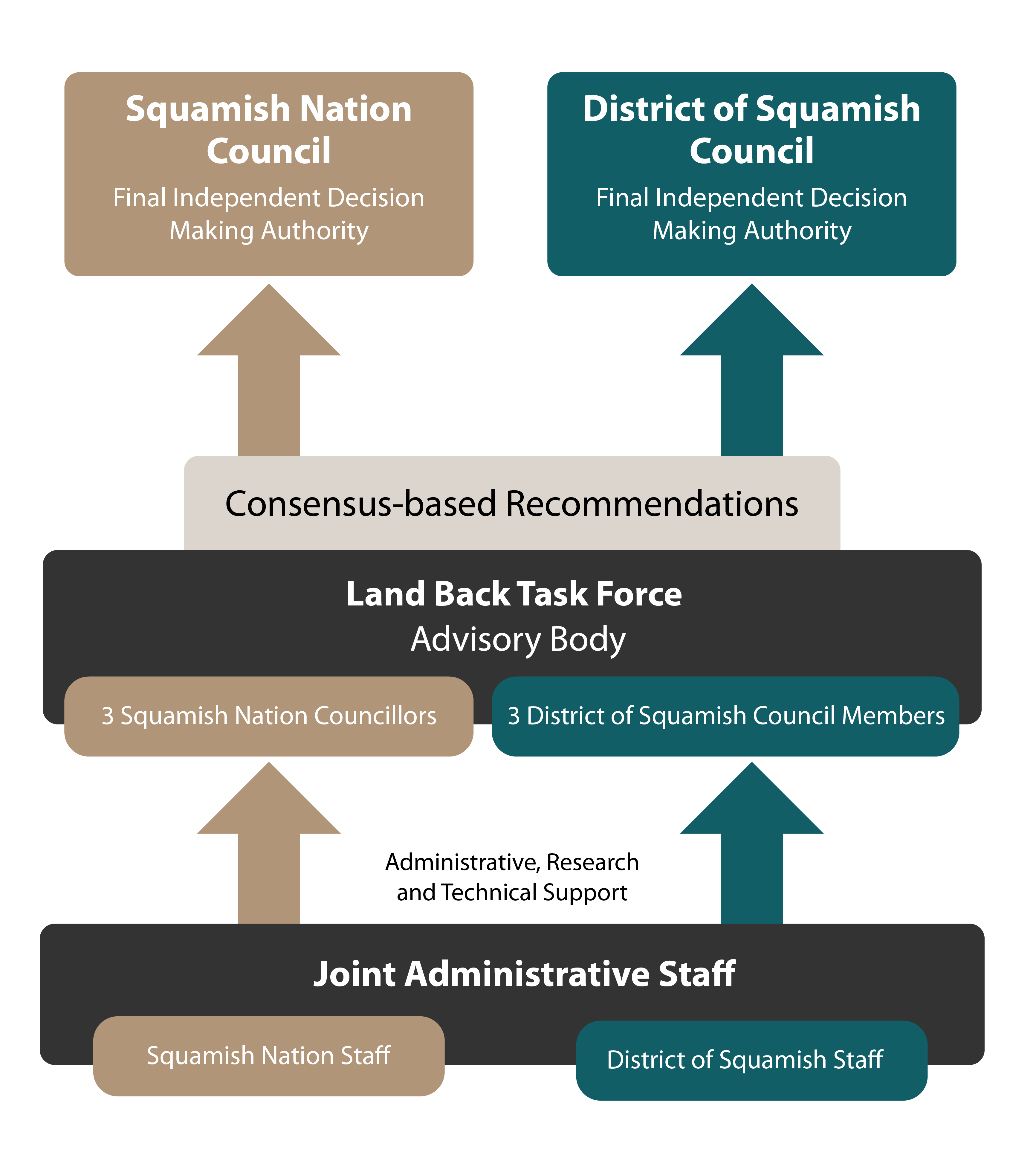
Land Back Task Force Decision-Making Flowchart
Decision-Making Authority: Sḵwx̱wú7mesh Nation and District Councils
All final decisions regarding Land Back initiatives, policy changes, or land dispositions remain solely with the Sḵwx̱wú7mesh Nation Council and District of Squamish Council. Final approval of the Land Back framework and associated recommendations must be granted by both Councils.
Advisory Body: The Land Back Task Force
The Task Force is a time-limited committee and the primary advisory body for the work. Composed of three members of Council appointed by each government, it reviews research, leads trauma-informed community engagement, and develops recommendations through a consensus-based approach. The Task Force does not have the authority to make binding decisions or act on behalf of either government.
Project Support: Joint Administrative and Technical Staff
Staff from both governments provide administrative and technical support. Responsibilities include conducting research on external Land Back initiatives and preparing inventories of District-owned lands. Staff develop the work plans and engagement plans for Task Force review and approval.