
Missing Middle Housing in Squamish

Missing-middle housing refers to small-scale, multi-unit housing forms that fall between single-detached home and large apartment buildings. These housing types help increase housing supply while fitting into existing neighbourhoods.
In Squamish, missing-middle housing plays an important role in addressing housing affordability, supporting a growing population, and creating more housing options for households at different life stages and income levels.
Why Missing-Middle Housing Matters
Squamish continues to experience population growth, which places pressure on housing supply and affordability. The District’s 2023 Housing Needs Report identifies the need for thousands of new homes over the coming decades, including housing that is attainable for middle-income households.
Missing-middle housing helps respond to this need by:
- Increasing housing supply within existing neighbourhoods;
- Providing ground-oriented housing options for families, seniors, and households looking to downsize;
- Supporting more efficient use of land and infrastructure;
- Creating opportunities for long-term community stability.
Housing Types Included
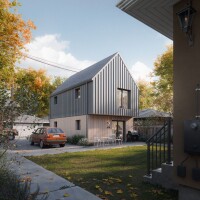
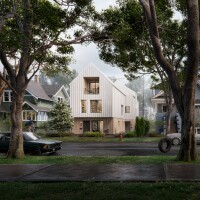
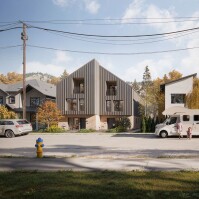
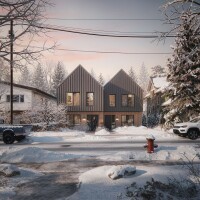
Missing-middle housing includes a range of small-scale, multi-unit housing forms, such as:
- Accessory dwelling units and secondary suites;
- Duplexes, triplexes, and fourplexes;
- Townhomes and rowhouses.
|
|
|
|
| Accessory Dwelling Unit | Duplex | Fourplex | Rowhouse |
Images above are courtesy of Canada Mortgage and Housing Corporation (CMHC)
These housing types are often similar in scale to single detached homes and are designed to fit within established residential areas.
What's Changed in Squamish
To support the delivery of missing-middle housing, the District has updated its Zoning Bylaw to allow more housing options on properties that were previously limited to a single dwelling unit.
In many residential areas, lots that once permitted a single-unit home and accessory unit may now accommodate up to four principal dwelling units, depending on zoning and site conditions. These changes increase flexibility for homeowners and builders while supporting modest, neighbourhood-scale growth.
The District's Role
The District of Squamish regulates land use through zoning, bylaws, and policy. These tools help create opportunities for additional housing, but the construction of homes is carried out by homeowners, builders, non-profit organizations, and developers.
>The District does not control housing prices or private market demand. Enabling missing-middle housing is one way the local government can support increased housing supply and housing choice over time.
Learn more about the District’s broader housing initiatives through Housing Action.
Provincial Legislation and Missing-Middle Housing
In late 2023, the Province introduced Bill 44 under the Homes for People program. This legislation requires municipalities to allow more small-scale, multi-unit housing in areas previously limited to single-detached homes.
In response, the District updated its Zoning Bylaw to align with provincial requirements and enable missing-middle housing across residential neighbourhoods.
In June 2024, Council adopted Zoning Bylaw Amendment Bylaw (Small-Scale Multi-Unit Housing) No. 3036, 2025. This update introduced the R-1 zone, rezoned many former RS-zoned properties, and added definitions and regulations to support small-scale, multi-unit housing. The R-1 zone applies to most residential properties outside flood hazard areas and enables a broader range of housing forms that were previously permitted.
In February 2025, Council adopted additional residential zones R-2, R-3, R-4, and R-5 for properties within flood hazard and conditional densification areas. These zones allow similar small-scale housing forms while incorporating additional siting, design, and density requirements to address flood risk and local site conditions.
Together these zoning updates support housing supply while responding to local constraints. They ensure Squamish’s zoning complies with provincial requirements and enables missing-middle housing across all residential areas, including properties within flood hazard areas.
Building Small-Scale Multi-Unit Housing
Small-scale multi-unit housing is the Provincial term for buildings with three or more attached dwelling units that are compatible in form and scale with surrounding residential development. In the District of Squamish Zoning Bylaw, these projects are called ‘multiple dwelling residential’; they are also referred to as Multiplexes.
Key considerations may include building height, lot coverage, unit size, parking requirements, and servicing. Detailed zoning regulations and development standards are available below.
Learn More
Building Complete Neighbourhoods
Missing middle housing plays a key role in building complete neighbourhoods that support both community wellbeing and climate action. By adding small-scale, multi-unit homes within existing areas, we can create neighbourhoods where more people live close to shops, schools, parks, and transit. This supports Big Move #2 of the Community Climate Action Plan by making it easier to walk, bike, or take transit instead of driving. Growing inward rather than outward helps reduce greenhouse gas emissions, lowers infrastructure costs, and creates connected communities designed for daily life.
Missing Middle Housing Mythbusters FAQ
The District of Squamish has developed the Official Community Plan and a series of master plans to guide appropriate population growth.
One of our primary concerns is to manage the costs associated with maintaining and building infrastructure. Increased infill housing spreads the costs of infrastructure across more residents, thereby reducing the cost-per-person; which, in turn, allows property taxes to remain as low as possible.
In addition, District policy is to ensure that growth pays for growth. This means that developers rezone land parcels, they are responsible for installing infrastructure to accommodate the development, and contributing community amenities. Doing this ensures that the cost of growth is not being passed down to taxpayers.
A common misconception is that the infill development boom in Squamish is encroaching upon our greenspaces and recreational zones. However, the reality is that building is taking place on private land that was already zoned for development.
We can’t stop the growth, but we can ensure that it takes place within our existing footprint. In fact, there is enough land within our growth management boundary to support a population growth of 34,000 (The Statistics Canada growth estimate for 2020 was 23,335).
Building more multi-family residences (such as townhomes, duplexes, triplexes and apartments) in our neighbourhoods means that we can make the most of the planned developments and accommodate population growth within our existing footprint, rather than sprawling outward and developing on the natural assets that surround Squamish.
While Squamish has traditionally been a car-centric community, this is not sustainable for the planet. Transportation in cars and trucks accounts for 52% of our community’s greenhouse gas emissions. We need to come together as a community to reduce our impact on climate change and change our behaviours.
The way our neighbourhoods are built affects our transportation behaviours—and our vision for the broader community is to shift beyond the car by creating neighbourhood nodes with parks, childcare, and daily amenities within a short walking distance.
Our Community Climate Action Plan (CCAP) outlines a strategy to provide more active and public transportation options for Squamish residents so they can reduce dependency on their vehicles. Neighbourhood infill allows us to fund infrastructure like bike and walking paths and reliable public transit. This is echoed in the CCAP.
The “missing middle” refers to the mid-range housing options like row houses, townhomes, co-housing, or walk-up apartment buildings. There will always be a place for single-family homes in Squamish. However, with the projected growth in our community, neighbourhood infill housing is the best way to create a resilient and liveable community, accommodate resident housing needs, and retain key recreation and environmental areas.
In Squamish, single-family homes account for 44% of our housing inventory—much higher than in Whistler (13%) and Pemberton (30%). We can’t keep building single-family homes in hopes that the housing prices will go down.
Managing housing growth in Squamish is a balancing act. We want to avoid sprawling into greenspace and recreational areas and keep costs as low as possible while infrastructure needs increase. We also need to provide affordable housing for a diverse range of incomes.
The best way to address all of the needs is to diversify our housing supply by integrating more housing forms within our existing neighbourhoods.