
Landfill Lateral Expansion
Project Status: Current
A lateral expansion of the Landfill to the east of the current Landfill, which is on-track to reach capacity in 2030.
- Description:
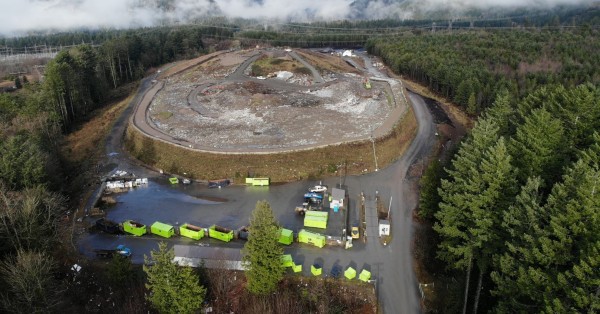
The Squamish Landfill is on track to reach capacity near the end of 2029. To ensure residents and businesses continue to have a local waste disposal option, the District of Squamish is pursuing a lateral Landfill expansion to the east of the current Landfill.
The lateral Landfill expansion aims to:
- Ensure capacity to manage waste for the next 25+ years
- Maximizing environmental protection in a fiscally responsible manner;
- Upgrade the Transfer Station to provide increased waste diversion opportunities, while being flexible so that it can adapt to future community needs
- Improve leachate (liquid that drains from waste) pre-treatment, before it enters the District’s sewer system;
- Utilize the unused, future phases of the landfill expansion area , to temporarily support circular economy and reuse initiatives;
Background:
The Squamish Landfill services District of Squamish residents and businesses, Skwxwú7mesh Úxwumixw (Squamish Nation) and parts of the Squamish Lillooet Regional District Electoral Area D (Britannia Beach, Furry Creek, and Squamish and Paradise Valleys).
In 2017, the District invested $6.5 million, into a vertical expansion at the southern end of the Landfill. The 10m wall allowed the Landfill to grow taller and keep its original footprint, instead of expanding into more land. This increased the lifespan of the Landfill from the original projected closure of 2018 to 2029.
Solid waste management in Squamish is guided by the 2016 Squamish-Lillooet Regional District’s (SLRD) Solid Waste Regional Master Plan (SWRMP) with oversight from the Ministry of Environment and Parks (ENV). The ENV has approved a focused amendment to the SWRMP for the lateral expansion of the Squamish Landfill, or the establishment of a transfer station if a lateral expansion cannot be pursued. While not anticipated, if it is determined during the process that a lateral expansion is not possible, or a temporary solution is required, the District will move forward with exporting waste to a landfill outside of the SLRD.
Design
The updated Concept Design (2023) incorporates the following four key goals:
- Showcase innovation and creativity, the District is looking for a flexible and leading-edge design that moves beyond “just a landfill”;
- Ensure that the design is efficient, values driven, and integrated with existing infrastructure to provide smooth and environmentally sound operations;
- Incorporate the District’s climate change and waste reduction goals, through the support of increased waste diversion, the beneficial reuse of materials and circular economy;
- Reduce the impact of leachate on the municipality’s sewer system.
Land
The District of Squamish acknowledges that the land identified for the lateral expansion is unceded land claimed by the Crown, which lies within the traditional territory of the Skwxwú7mesh Úxwumixw (Squamish Nation).
The District submitted an application for a sponsored Crown grant for the parcel of land to the east of the current Squamish Landfill in 2021. It is anticipated that this application process will take up to five years to complete and stakeholders will be engaged directly by the Ministry of Water, Land and Resource Stewardship and the Ministry of Forests.
In the meantime, the District has applied for a temporary Investigative Use License, to proceed with investigative works on the land, which will provide the data and information required by the ENV for their permitting process.
Project Timeline:
Year Activity 2020 District of Squamish and Squamish Nation endorsed the lateral expansion in principle. 2021 Sponsored crown grant for the parcel of land to the east of the current Squamish Landfill was submitted to the Ministry of Lands. 2022 Public engagement summary for the focused amendment of the SLRD’s SWRMP. 2023 ENV approved the SLRD SWRMP focus amendment regarding the lateral landfill expansion. Archaeological Impact Assessment completed with no findings. A Chance Find Management Plan was developed to be used during construction. Concept Design Update & Site Development Plan completed. Incorporated findings from the Debris-Flow Hazard Risk Assessment. A secondary analysis will be integrated into the detailed design. Preliminary application for Waste Discharge Authorization amendment submitted to the ENV. 2024 Upgrades of pre-existing transfer station area initiated. Application for Investigative Works was submitted to the Ministry of Lands. 2025 Initial (partial) application for the Waste Discharge Authorization was submitted to the ENV. It did not include works related to the hydrological and hydrogeological characterization report (HHCR), as that requires the investigative works approval by the Ministry of Lands, which will be completed as soon as authorization has been granted. 2026 Investigative works for the HHCR will be completed. Completed application for the Waste Discharge Authorization will be submitted to the ENV for review. Land Acquisition from the Province is anticipated. 2026-2027 Detailed Design for Transfer Station Upgrades & Landfill 2027-2029* Clearing of Trees and Construction for Transfer Station Upgrades & Landfill (dependent upon land acquisition and MOECCS approval) End of 2026 Start filling in Expansion Area 2031 Identify Temporary Uses for the currently unused future expansion area. All dates are anticipated. The timeline is subject to change as there are many factors that could impact it.
*The Landfill construction will be dependent upon the waste diversion of the community. If we are able to extend the lifespan of the current landfill, there is potential that the Landfill construction is delayed slightly.The Landfill and the Environment
Waste Diversion:
- At the Southern end of the Squamish Landfill site is a Transfer Station and Free Recyclable Depot.
- This area is accessible by the public, and provides recycling opportunities for many different materials, including, wood, yard waste, mattresses, glass, metal, small appliances, electronics, drywall, books, textiles, organics, cardboard, Styrofoam, invasive species, paper and hard and soft plastics.
- This area is heavily utilized by residents and businesses. As the community pursues its journey towards zero waste, the District views the expansion as an opportunity to increase diversion of different materials, beyond what is currently offered.
Environmental Monitoring:
- The Landfill operates under Operational Certificate #106063 and undergoes regular environmental monitoring and operates in compliance with the Ministry of Environment and Climate Change Strategy’s (MOECCS) Landfill Criteria. The Landfill submits Annual Monitoring and Operational reports to the MOECCS.
Landfill Gas Flaring:
- In 2021, the District completed the installation of a landfill gas extraction and flaring system (LFG system) at the site. In 2024, horizontal collectors were installed to increase the gas collection.
- Landfills produce landfill gas (LFG), which is a natural product of the breakdown of organic materials in a landfill – it is composed of roughly 50% carbon dioxide and 50% methane. Methane is a powerful greenhouse gas, some 28 to 34 times more so than carbon dioxide.
- The LFG system uses vertical wells which are drilled into the closed (northern) portion of the Landfill and horizontal gas collectors which are laid over the active (southern) portion of the Landfill. These are connected by piping that delivers the landfill gas to the flare.
- The purpose of flaring of the LFG is to dispose of the flammable constituents, particularly methane, safely and to control odour nuisance, health risks and adverse environmental impacts.
- The District is in the process of assessing the quality and quantity of the LFG and potential beneficial uses (beyond flaring).
- Neighbourhood:
- Brackendale
- Categories:
- Solid Waste Utility