
An Update from the Land Back Task Force
Fall 2026
Land Back Task Force work is currently underway. This update is being shared before the election, after which District of Squamish Council representatives from the newly elected Council will be appointed.
Sḵwx̱wú7mesh Úxwumixw (Squamish Nation) and the District of Squamish established the Land Back Task Force (Task Force) in 2026 to explore a way forward together, and a shared vision on how to work together for the benefit of the land and the people.
The Nation and District want to provide clear information about the work underway, how the Task Force will proceed and what the public can expect next.
The Task Force is an advisory body made up of representatives from Squamish Nation Council and District of Squamish Council (three from each). The Task Force does not have the authority to make final decisions or transfer public land, including Crown land. Its role is to conduct research, engage with the community and develop a series of recommendations for consideration to both councils.
Work completed so far
To date, the Task Force has met four times.
- The first meeting focused on building a shared understanding of the mandate and vision.
- The second explored the research and engagement process, including what information or research is needed, who should be involved, and how to set up a transparent process that informs and engages with Sḵwx̱wú7mesh People and District residents.
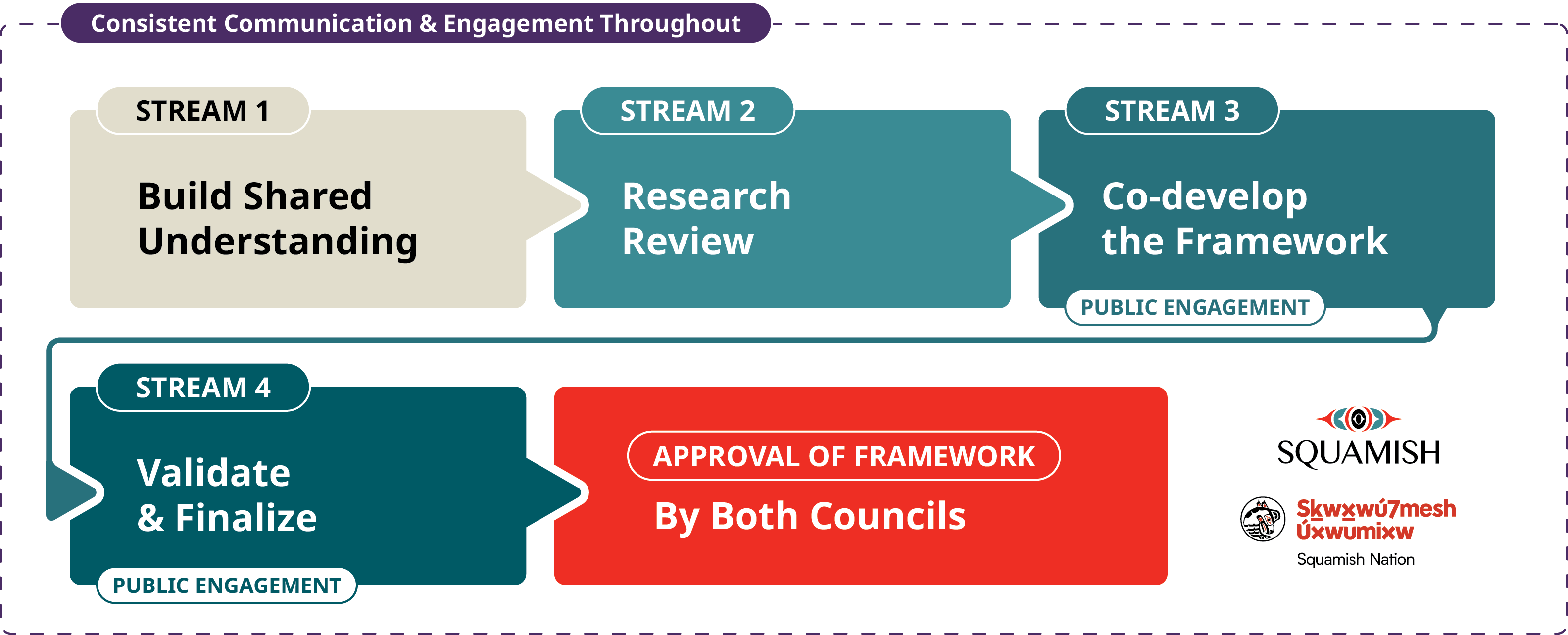
- The third meeting reviewed a proposed roadmap for developing a land back framework, setting out four connected streams, and how research, communications and engagement will be sequenced.
- The fourth meeting approved a roadmap for developing a land back framework that integrates consistent communication and engagement with the public, interested and affected parties and Sḵwx̱wú7mesh People.
After the District of Squamish municipal election, members of Council will be appointed to the District’s three seats. The Task Force will then reconvene to refine its approach and next steps. Because reconciliation may look different for each category of public land, the task force will take the time needed to understand those differences before developing recommendations.
Different lands may require different approaches
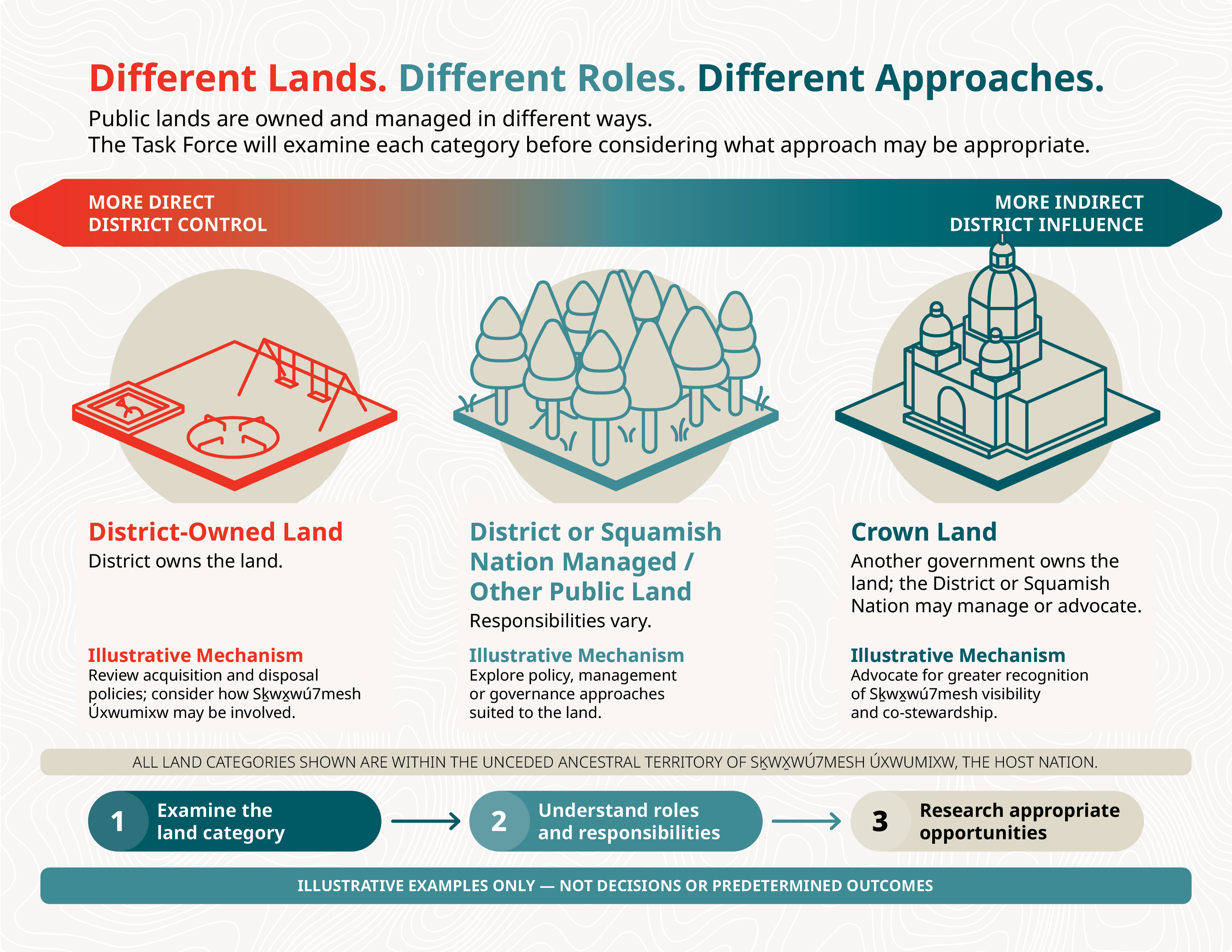
Public lands in the Squamish valley are owned and managed in different ways. Some are directly owned or managed by the District. Others are Crown and Crown Agency lands (owned by the provincial or federal government) where the District or Nation may have management responsibilities or a role in advocating to other levels of government. For example, Squamish Nation has different levels of management responsibility on various lands, from forestry tenures to collaborative management on recreation, to joint land use planning. In a similar way the District has management responsibilities over Crown lands such as Brennan Park by way of a Sponsored Crown Grant.
The Task Force will examine each category before considering what approach may be appropriate.
Examples are:
- Reviewing District land acquisition and disposition policies to determine how Squamish Nation may be involved when District-owned land is being considered for sale.
- Advocating to the provincial or federal government and Crown Agencies for greater recognition of Sḵwx̱wú7mesh co-stewardship on Crown land
- Considering different policy, management or governance approaches for other public lands.
These examples are intended to illustrate the kinds of opportunities that may be researched. They are not decisions or predetermined outcomes.
What affirming rights, title and jurisdiction could mean
The appropriate approach will depend on the land and how it is currently owned or managed. It could include:
- Greater Sḵwx̱wú7mesh involvement in planning or stewardship.
- Shared decision-making or management arrangements.
- Restoration of Sḵwx̱wú7mesh place names.
- Greater visibility of Sḵwx̱wú7mesh history, culture and presence.
- Access for cultural, ceremonial or harvesting purposes.
- Changes to District land policies.
- Advocacy to other levels of government.
In some cases, the most appropriate approach may involve greater Sḵwx̱wú7mesh visibility, presence or involvement in the stewardship of a place rather than a change in ownership or public access.
The Task Force's scope of work does not involve privately owned (fee-simple) property, and residents with private land holdings will not be impacted. The Task Force will focus on research, learning and engagement to inform the restoring of Squamish Nation governance, stewardship and cultural connection to lands currently under public jurisdiction.
What comes next
Following the election and appointment of new District Task Force members, the Task Force will continue to:
- Research the different categories and ownership of public land
- Review District land policies and decision-making processes
- Look at approaches used in other communities
This work will help identify practical ways to include Squamish Nation more meaningfully in the planning, management and stewardship of public lands.
The Task Force is also developing an engagement process to hear the questions, priorities and perspectives of District residents and Sḵwx̱wú7mesh People. More information will be shared once the timing and opportunities to participate are confirmed.
Further updates will explain what has been completed, what is being considered and how any recommendations will move forward. Squamish Nation and the District of Squamish are committed to approaching this work thoughtfully and transparently, with no decisions made before the research and public engagement process is complete.
For current information and latest updates on the Task Force work, visit the MOU Webpage.
September 16, 2026