Community Climate Action Plan
Big Moves: A Climate Action Plan for the District of Squamish
A healthy environment is vital to our culture, well-being, and local economy. In Squamish, climate change impacts like wildfires, sea level rise, and floods are affecting how we live, work and play. The District of Squamish has developed a Community Climate Action Plan (CCAP) to reduce community greenhouse gas (GHG) emissions. The District has also developed an Adaptation Strategy to prepare for the impacts of climate change.
Goal
By 2030 the District of Squamish's goal is to reduce emissions.....That's the equivalent of avoiding 2.3 million round trips from Squamish to Vancouver a year.
What We Are Doing
The CCAP, Adaptation Strategy, and other plans and policies help build a healthier and more resilient future for Squamish. The CCAP’s Six Big Moves focus on reducing (or mitigating) emissions created by transportation, waste, and buildings. Adapting to a changing climate is equally important. Flood protection, wildfire prevention, and emergency preparedness play a crucial role in adaptation work.
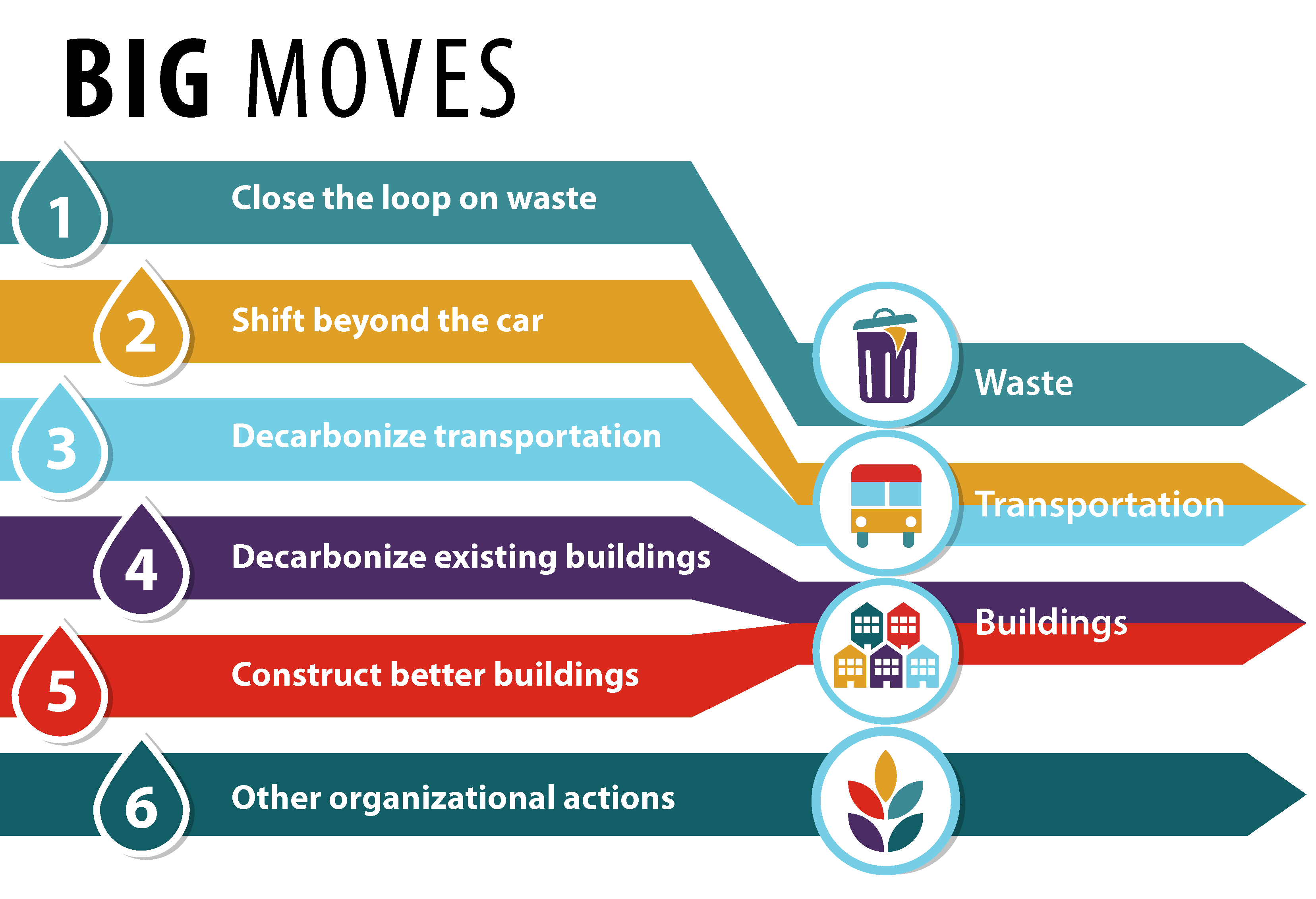
Building a Resilient Future With the 6 Big Moves & Adaptation
Long-term Vision: Our community diverts all organics and recovers value from waste.
2030 Goal: Decrease landfill gas emissions by 90%.
Landfills emit methane, a powerful Greenhouse Gas (GHG) that accounts for 20% of Squamish’s emissions. The District has developed a Zero Waste Strategy and is working to keep food scraps, yard waste, and other reusable materials out of the landfill. Solutions include: proper waste disposal and other ways of recycling or composting. At the landfill, a gas collection system captures methane emissions, reducing pollution and creating a future energy source.
Long-term Vision: Active transportation and transit are preferred modes of travel to and within Squamish.
2041 Goal: 50% of the time, people will travel around town by walking, rolling, taking transit or using e-bikes and e-scooters.
Gas vehicles create the largest share of local emissions. Shifting beyond the car means making it easier, safer, and more appealing to walk, roll, or take transit for everyday trips. This includes improving transit service and investing in sidewalks, bike lanes, multi-use pathways, and trails. Planning neighbourhoods with shops and services close to home also reduces the need to drive. At the same time, Squamish residents will continue to own cars and drive when necessary for various reasons. This is why Big Move 3 offers a complementary approach.
Long-term Vision: Electric (or low-carbon) cars, buses, fleets, and larger vehicles are the preferred option.
2030 Goal: 50% of kilometres driven are by Zero Emissions Vehicles (ZEVs).
Even as people drive less, vehicles will still be part of life in Squamish. Decarbonizing transportation includes supporting electric and low-carbon vehicles, expanding public electric vehicle (EV) charging, and helping residents and businesses switch away from gas and diesel. The District is also working on cleaner options for commercial fleets and purchasing EVs for the municipal fleet.
Long-term Vision: Energy retrofits occur in all types of buildings in Squamish.
2030 Goal: 3% of homes retrofitted and 2% of homes switch to heat pumps per year, with an average 33% GHG reduction in building emissions.
Buildings use lots of energy and are the second largest source of community emissions. Programs like Retrofit Assist help building owners switch to low-carbon heating and cooling sources (like heat pumps), and complete energy efficiency upgrades, such as windows and insulation. The District of Squamish is starting to encourage the use of renewable energy sources like solar panels, to further reduce building emissions.
Long-term Vision: New buildings are efficient, use low-carbon energy sources and have lower embodied emissions.
2030 Goal: All new buildings are efficient, low-carbon and have reduced embodied emissions.
New buildings create community emissions, but there is also an opportunity to ensure they are built as sustainably as possible. District policies ensure new builds use clean energy, support EV use, and are efficient. The District is also exploring policies to reduce “embodied carbon,” which are the emissions created when materials like concrete and steel are made and transported.
Long-term Vision: Squamish continues to learn, improve and prepare for a low-carbon future.
2030 Goal: District of Squamish leads by example on climate action.
The District of Squamish is lowering emissions from corporate operations. The Municipal Energy and Emissions Plan (MEEP) includes actions like electrifying the municipal vehicle fleet, retrofitting existing District buildings, and ensuring new facilities (like fire halls) are low-carbon and energy-efficient.
Long-term Vision: Ensuring Squamish is more resilient in the face of climate change.
Goal: Reduce the negative impacts of climate-related events on the community of Squamish.
Reducing emissions is only part of the work. Adapting to climate-related events helps protect people, homes, infrastructure, and natural areas. The Adaptation Strategy plans for sea-level rise and flooding, upgrades dikes and drainage systems, improves wildfire resilience, and strengthens emergency preparedness. It also recognizes the role of nature areas (such as wetlands, forests, and rivers) in reducing risk and supporting long-term resilience.
Learn More About Our Focus Areas
See Our Progress
Since adopting the CCAP in 2020, Squamish has been recognized as a climate action leader in many areas. The District has made progress on 78% of the plan’s 122 Actions and has secured over $3 million in funding to support climate action initiatives like EV charging stations and municipal building retrofits.
Landfill Gas System
Captures 75% of methane from the landfill and will turn it into a usable energy source in the future.
Category: Waste
Launched: 2021

Deconstruction Bylaw
Requires the reduction of at least 80% of demolition waste.
Category: Waste
Launched: 2024

Transportation Master Plan
Connects Squamish through roads, trails, and pathways prioritizing accessibility and active transportation.
Category: Transportation
Launched: 2025

Electric Vehicle Adoption
Squamish had the fastest-growing rate of EV adoption in Canada in 2022.
Category: Transportation
Completed: Ongoing

Zero Carbon Step Code
Squamish has adopted the highest level of the BC Zero Carbon Step Code to support low-emissions development.
Category: Buildings
Launched: 2024

Retrofit Assist Program
The program supports Squamish residents with retrofitting buildings to make them more energy efficient.
Category: Buildings
Launched: 2020